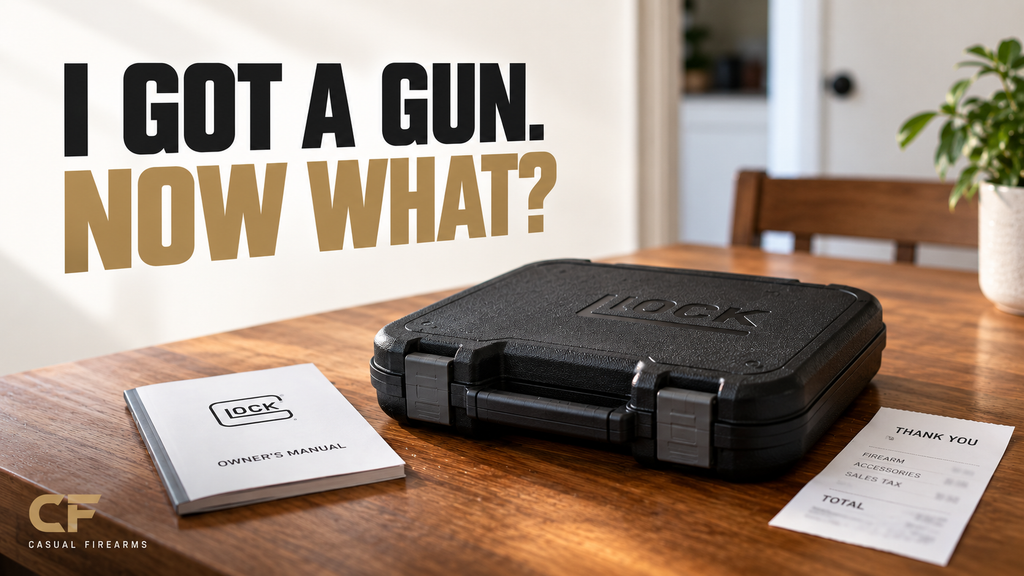
So, you bought a gun.
If you’re reading this, it’s probably your first one. Maybe somebody helped you pick it out. Maybe you spent three weeks watching videos and reading everything you could find before finally making a decision. Or maybe you walked into a gun store, asked the salesman which gun you should buy, maybe found something that felt comfortable in your hand, and said, “Yes, I’ll take this one.”
Either way, now you own a firearm.
So… now what?
Buying the gun is actually the easy part. Becoming comfortable, competent, and responsible with it takes a little more work.
The good news is that you don’t have to learn everything today. You don’t need to memorize an encyclopedia of firearms terminology (But we have you covered, Click Here), buy a pile of accessories, or become a “gun person” overnight.
You just need to know what to do next, and you want to be sure you’re on the right path.
Start With the Gun You Bought
Before worrying about ammunition, holsters, optics, upgrades, or your first trip to the range, spend a little time learning about the firearm that’s sitting in front of you.
And yes, we’re going to say the thing nobody wants to hear:
Read the owner’s manual.
We’re not just saying this because it covers our butts, you’re likely to find some good information in there that you did not know. You don’t have to memorize it, but you should know how your particular firearm is designed to operate, what its controls do, and what the manufacturer recommends for its use and maintenance.
Different firearms work differently. Something you learned about another gun, saw in a video, or heard from a friend may not apply to yours.
If you’re not comfortable handling it yet, that’s okay. You don’t need to figure everything out by experimenting.
That’s a great reason to find an instructor.
Learn the Safety Rules
There are different ways you’ll see the fundamental rules of firearm safety worded, but the principles are remarkably consistent.
Treat every firearm with the respect you would give a loaded firearm. Keep the muzzle pointed in a safe direction. Keep your finger away from the trigger until you’ve made the conscious decision to fire. Know what you’re shooting at and what is around and beyond it.
More importantly, don’t just memorize the words.
Understand WHY those principles exist, how they compliment one another, and why they are ALL necessary.
Safe firearm handling isn’t something you do only at the range. It applies when you’re taking the gun out of its case, cleaning it, showing it to someone, storing it, practicing with it, and putting it away. Anytime you’re handling a firearm you want to be present in mind and deliberate with your actions.
Eventually, those habits should become boring.
Boring is good. Complacent is not.
Figure Out How You’re Going to Store It
Before your new gun develops a permanent home on top of the dresser, figure out where it’s actually going to live.
The right storage solution depends on your circumstances. A person living alone may have different considerations than someone with children in the home. A firearm intended for home defense may need to be stored differently from a collection that rarely leaves the safe.
The goal is to prevent unauthorized access while still meeting whatever legitimate purpose you bought the firearm for.
You don’t necessarily need a giant safe bolted to the foundation of your house on day one. Depending on your circumstances, a quality lockbox, handgun safe, locking cabinet, or other secure-storage solution may be appropriate.
What matters is that storage is something you think about intentionally, rather than figuring it out after there’s a problem.
And because storage and access laws vary by location, make sure you understand the laws that apply where you live. A good place to start is your state government’s website or another official state resource.
Get Some Training
YouTube is useful.
Articles like this one are useful.
A knowledgeable friend can be useful.
None of those completely replaces having a competent instructor standing beside you and helping you learn.
Good beginner instruction isn’t about turning you into John Wick. It should help you become comfortable handling your firearm safely, understand how it works, learn the fundamentals, and give you a foundation you can continue building on.
You also don’t need to wait until you’re “good enough” to take a class.
Learning is the reason you take the class.
If you’re nervous, unfamiliar with firearms, or worried that everyone else will know more than you, tell the instructor beforehand. A good instructor should be perfectly comfortable working with someone starting at zero.
Everyone starts somewhere.
Your First Range Trip Doesn’t Need to Be Complicated
You don’t need to show up with six guns, twelve magazines, a tactical backpack, a shot timer, and 500 rounds of ammunition.
You’re learning.
Keep the first trip simple.
Make sure you understand the rules of the range you’re visiting. Bring the eye and hearing protection required by the facility, appropriate ammunition for your firearm, and the basic equipment you actually need. But also, any basic items you’re missing they will most likely either rent it to you, or sell it to you.
Then give yourself permission to go slowly.
Your first range trip doesn’t need to be about shooting tiny groups or seeing how quickly you can empty a magazine.
Learn how the gun feels. Learn how it recoils. Work on safe handling. Listen to your instructor or range staff. Ask questions when you don’t understand something. Tell the RSO (range safety officer) you’re new and he’ll probably be excited to give you a short intro into your specific firearm, bare minimum he’ll ensure you know all the range procedures and point you on the right path if you have questions.
Twenty thoughtful rounds can teach you more than 200 rounds fired without any particular purpose.
Don’t Start Buying Upgrades Yet
This one might save you some money.
You probably don’t know what you want yet.
That’s not an insult. You haven’t had enough time with the gun to know.
The internet will happily tell you that you immediately need a new trigger, different sights, a weapon light, an optic, an extended magazine release, a compensator, a different grip texture, six magazines, and $300 worth of other stuff.
Maybe you’ll eventually want some of those things.
Shoot the gun first.
Learn what you actually like and dislike. Figure out whether a perceived problem is really an equipment problem or simply something you haven’t learned yet.
Your opinions will probably change as your experience grows.
Let them.
Spend some time getting familiar with the firearm in its base configuration before you start changing things. Later, when you do make changes, you’ll actually understand what problem you’re trying to solve.
Learn Basic Maintenance
Your firearm doesn’t need to become another household appliance you’re afraid to take apart.
At some point, you’ll need to learn the basic maintenance recommended by its manufacturer: how to inspect it, clean it, lubricate it, and recognize something that doesn’t look right.
Again, the owner’s manual is your friend here.
You don’t need to become an armorer. You just need enough familiarity to properly care for the equipment you own and enough judgment to know when something should be looked at by somebody more qualified.
What’s fun is there is some YouTuber who did a very good, very detailed dissassembly, reassembly and cleaning of your specific firearm and they are dying for you to watch their video. Just go to YouTube and give your firearm a search. Oh, and while you’re there, Give Our YouTube a Follow!
Then Practice
Taking one class doesn’t make you proficient. Just like taking one piano class doesn’t make you Mozart.
Neither does getting a concealed carry permit, firing a box of ammunition, or owning a gun for twenty years.
Skill comes from practice. Practice doesn’t make perfect, but practice makes better.
That doesn’t mean you need to live at the range or spend hundreds of dollars on ammunition every month (like some of us). It means occasionally spending some intentional time maintaining and improving upon what you’ve learned.
As you gain experience, you’ll start discovering what you actually need to work on.
That’s when practice becomes much more useful.
You Don’t Have to Learn Everything at Once
Shooting can become as deep of a rabbit hole as you want it to be.
There are endless arguments about equipment, techniques, ammunition, training methods, defensive use, competition, maintenance, modifications, and just about everything else.
You don’t need all of that right now. You don’t need to know those things. You don’t need to talk about those things.
If you just bought your first firearm, your immediate job is much simpler:
Learn what you bought. Learn to handle it safely. Store it responsibly. Get some competent instruction. Go shoot it. Then keep learning.
That’s enough.
You bought a gun.
Now start learning how to be good with it.
And have some fun. This is supposed to be fun!